

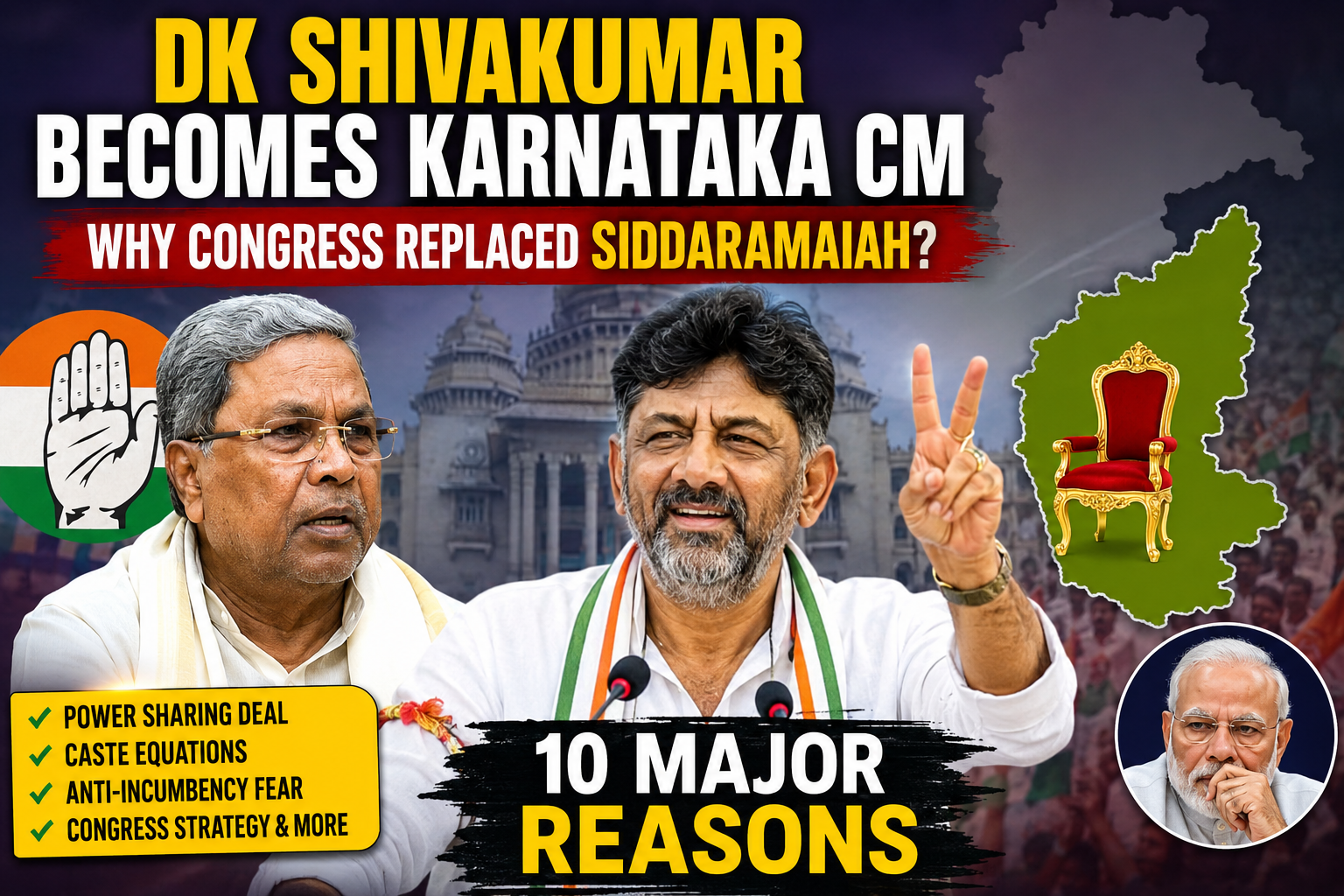
Congress replaced Siddaramaiah with DK Shivakumar as Karnataka Chief Minister ahead of the 2028 Assembly elections. Here are the 10 major reasons behind the leadership change.
Why Congress Chose DK Shivakumar as Karnataka’s New Chief Minister :10 Major Factors Behind Karnataka’s Leadership Change.
The Congress leadership decided to replace Siddaramaiah with D K Shivakumar as Karnataka Chief Minister two years before the next Assembly elections. Although rising anti-incumbency concerns played a role, several political and organisational factors also influenced the decision.
1. Power-Sharing Agreement
One of the biggest reasons behind the leadership change was the informal power-sharing arrangement reportedly reached after Congress secured a massive victory in the 2023 Karnataka Assembly elections. Under the joint leadership of Siddaramaiah and DK Shivakumar, the party won 135 out of 224 seats. The agreement paved the way for Shivakumar to eventually take over the top post.
2. Strategy to Counter Anti-Incumbency
DK Shivakumar ,Karnataka voters have traditionally preferred changing governments every five years. Congress hopes that D K Shivakumar’s strong organisational skills and long-term ambitions will help the party overcome the anti-incumbency trend and secure a second consecutive term in 2028.
3. Caste Equations and Electoral Calculations
Caste dynamics have always played a decisive role in Karnataka politics. Congress believes that combining its traditional support base among OBCs, Dalits and minorities with the influence of the Vokkaliga community represented by Shivakumar could strengthen its chances in future elections.
The party is also hoping to attract voters who previously supported the JD(S), especially after the regional party aligned with the BJP.
Read This :- Bellary DCC Bank Recruitment 2026 Announces 82 Vacancies
4. Rewarding Loyalty to the Congress
D K Shivakumar has long been considered one of the most loyal leaders of the Congress and the Gandhi family. His elevation to the Chief Minister’s post sends a message to party workers that dedication and loyalty are recognised and rewarded.
Unlike Siddaramaiah, who joined Congress in 2006 after leaving the JD(S), Shivakumar has spent decades building the organisation from within.
5. Siddaramaiah’s Reduced Administrative Control
As the power struggle between the two leaders intensified, Siddaramaiah’s authority over the administration reportedly weakened. Several key sectors such as Bengaluru development, irrigation and water resources were largely under DK Shivakumar’s influence.
This dual power structure allegedly affected governance and contributed to administrative inefficiencies.
6. Weakening of the Chief Minister’s Office
Sources indicated that multiple centres of influence emerged around the Chief Minister’s Office during Siddaramaiah’s second term. This reportedly led to dissatisfaction among ministers and bureaucrats and affected administrative coordination.
7. Need to Strengthen the Party Organisation
Congress also faced challenges in expanding and strengthening the Karnataka Pradesh Congress Committee (KPCC). With Shivakumar holding both the Deputy Chief Minister and KPCC President positions, organisational reforms were delayed.
The leadership change enabled Congress to restructure the state unit and bring in new faces to balance internal power equations.
8. Concerns Over Internal Rebellion
Internal disagreements during the Davangere South by-election raised concerns within the party leadership. Allegations of factionalism and dissatisfaction among leaders prompted fears that internal divisions could hurt Congress ahead of future elections.
Changing the leadership was viewed as a step towards maintaining unity and avoiding further damage.
9. Growing Confidence Within Congress
Congress recently witnessed successful political developments in southern states, which boosted the party’s confidence. The leadership believes that a generational shift and fresh leadership can inject new energy into the organisation and improve its electoral prospects.
10. Shivakumar’s Development-Oriented Image
D K Shivakumar has cultivated an image as a pro-business and urban-focused leader. He has actively promoted Bengaluru as a global investment destination and positioned himself as a leader capable of accelerating infrastructure and economic growth.
His participation in international forums and emphasis on development have strengthened his appeal among investors and urban voters.
Read This :-Karnataka Free Site Scheme 2026 Could Change Thousands of Lives
Challenges Ahead for DK Shivakumar
Although DK Shivakumar has finally achieved his long-cherished dream of becoming Karnataka Chief Minister, his biggest challenge will be to maintain unity within the Congress party and ensure that different groups and leaders work together ahead of the 2028 Assembly elections.
Many political observers believe that balancing the expectations of Siddaramaiah supporters and his own loyalists will be one of the toughest tasks before the new Chief Minister. Any signs of internal conflict could provide an opportunity for the BJP and JD(S) to strengthen their position in the state.
Importance of Bengaluru’s Development
As a leader with a strong urban and development-oriented image, DK Shivakumar is expected to focus heavily on Bengaluru. Issues such as traffic congestion, water scarcity, flooding, waste management and infrastructure development are likely to be among his top priorities.
Bengaluru remains Karnataka’s economic engine and contributes significantly to the state’s revenue. Therefore, improving the city’s infrastructure and attracting fresh investments will be crucial for the success of the new government.
Industry leaders and investors are also expected to closely watch the new administration’s policies on technology, startups and industrial growth. A stable and business-friendly environment could further enhance Karnataka’s reputation as India’s innovation hub.
Congress Eyes Consecutive Victory
DK Shivakumar Historically, Karnataka has rarely voted for the same party in two consecutive Assembly elections. This makes the 2028 elections extremely important for Congress.
By appointing DK Shivakumar as Chief Minister, the party is hoping to break the traditional anti-incumbency trend. Congress leaders believe that a combination of welfare programmes, development initiatives and strong organisational support can help them secure another term.
The party is also expected to strengthen its outreach among youth, women and first-time voters in the coming years. Social media campaigns and grassroots activities are likely to play an important role in this strategy.
External Resources
- Indian National Congress Official Website
https://www.inc.in/ - Election Commission of India
https://eci.gov.in/ - Government of Karnataka Official Portal
https://karnataka.gov.in/ - World Economic Forum
https://www.weforum.org/
Opposition Parties Preparing Their Strategy
The BJP and JD(S) are also expected to intensify their political campaigns following the change in leadership. The opposition parties are likely to target the Congress government over governance, corruption allegations and unfulfilled promises.
At the same time, Congress will attempt to highlight its welfare schemes and development projects to retain public support. Political analysts believe that the competition between the ruling party and the opposition could become more intense as the next elections approach.
Expectations From the New Leadership
DK Shivakumar People across Karnataka have high expectations from the new Chief Minister. Farmers, businessmen, employees and young professionals are looking for policies that promote economic growth, employment opportunities and better infrastructure.
Citizens are also expecting improvements in education, healthcare, transportation and urban planning. How effectively the government addresses these issues could determine its popularity in the years ahead.
A Defining Phase for Karnataka Politics
DK Shivakumar The change in leadership marks a significant moment in Karnataka’s political history. While Siddaramaiah’s tenure focused largely on welfare and social justice, DK Shivakumar is expected to bring a stronger emphasis on infrastructure, investment and economic development.
The coming months will reveal whether this transition helps Congress strengthen its position or creates new political challenges. One thing is certain: the road to the 2028 Karnataka Assembly elections has already begun, and every major decision taken by the new government will be closely watched by political parties, industry leaders and voters alike.
With high stakes involved, the leadership change could ultimately become one of the most defining moments for Congress in Karnataka. The success or failure of this strategy may not only influence the state’s political future but could also have implications for the party’s prospects at the national level.
Conclusion
The replacement of Siddaramaiah with DK Shivakumar appears to be a carefully calculated political move rather than a sudden decision. Congress is aiming to balance caste equations, energise
its organisation, reward loyalty and prepare for the 2028 Assembly elections.
Whether the strategy succeeds in helping Congress retain power for a second consecutive term remains one of the biggest questions in Karnataka politics.
1 thought on “DK Shivakumar Becomes Karnataka CM: Shocking Reasons Why Congress Replaced Siddaramaiah”